Our Services

Hydraulic Conductivity
Testing

High-quality packer and pumping tests to quantify permeability and
water movement in rock.

Understand groundwater behaviour with confidence.

Accurate permeability data is essential for geotechnical, mining, tunnelling and infrastructure design. Without reliable measurements, engineers risk underestimating inflows, mischaracterising rock mass behaviour, or designing ineffective dewatering and grout programmes. Our hydraulic conductivity testing provides the dependable data needed to make informed design and construction decisions.
Our solutions.

Comprehensive Hydraulic Conductivity
Testing Solutions
.

GE Monitoring Systems performs fully instrumented packer and pumping tests, providing engineers with precise flow, pressure and calculated outputs such as Lugeon and hydraulic conductivity K values.

Packer Testing Methods

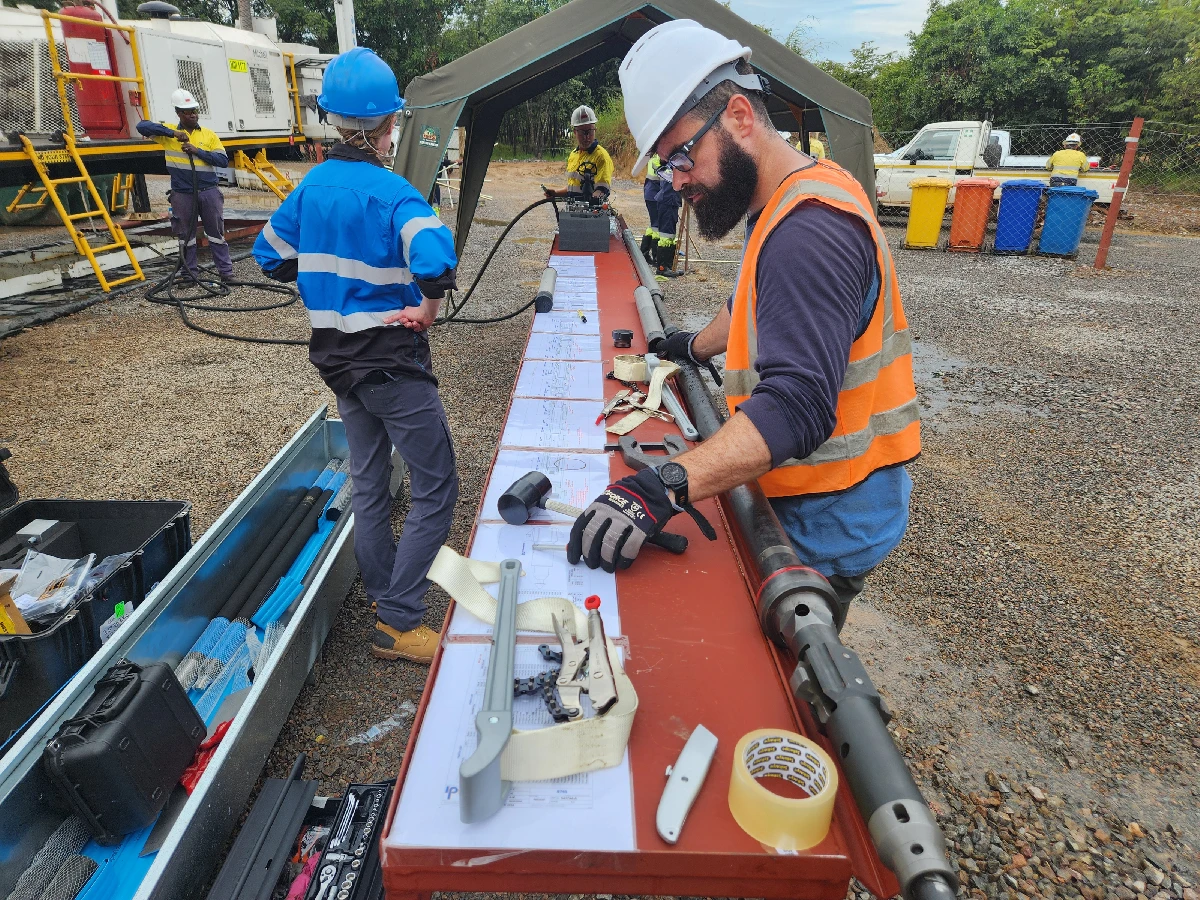
Packer testing isolates a section of a borehole using inflatable elements and evaluates hydraulic conductivity by pumping water into the test interval at controlled pressures while monitoring flow and pressure responses. GE Monitoring Systems offers three complete packer systems, suitable for both in-progress drilling and post-drilling investigations.

Conventional packers are pneumatically inflated using nitrogen and installed in open or partially cased boreholes after drilling is complete. A vibrating-wire piezometer is mounted directly on the packer and lowered with the assembly, providing live pressure readings inside the test interval throughout the test.

Testing involves inflating the packer, applying staged pressures, and recording flow and pressure until stabilised values are achieved. A straddle-packer configuration may be used to isolate shorter intervals by adding a second inflatable sleeve below the primary sealing element.

Depth capability: typically 350–400 m, depending on borehole conditions.

Used for:

  • Permeability / hydraulic conductivity assessment

  • Lugeon testing

  • Grout verification

  • Casing integrity checks

  • Isolating specific intervals in completed boreholes

Wireline packer testing is performed during active diamond drilling. The packer assembly is lowered through the rods and lands at the bit, with one inflatable sleeve below the bit and another inflatable sleeve seated inside the core barrel, isolating the section between the bit and the bottom of the hole.

A straddle-packer configuration can be added by installing a third inflatable sleeve below the primary packer to isolate a shorter interval.

A vibrating-wire piezometer is suspended inside the rods to provide live pressure readings during testing.

Depth capability: typically 350–400 m, depending on borehole conditions.

Used for:

  • Assessing hydraulic conditions during drilling

  • Identifying water-bearing or high-flow intervals

  • Multiple tests during drilling without removing rods

  • Targeted interval testing immediately after coring

Hydraulic packer systems use water rather than nitrogen for inflation. The rods are filled, inflation pressure is applied hydraulically, and the rods are mechanically set to lock the packer in place before flow into the test section begins.

SWIPS System
Uses two inflatable sleeves—one inside the core barrel and one below the drill bit. Both sleeves are hydraulically inflated, and the rods are set to lock the system in place.

STX System
Uses a solid landing shoulder that seats on the core barrel’s landing ring, forming the upper seal with a metal-to-metal interface supported by a small sealing surface.
A single inflatable sleeve below the bit forms the lower boundary.

A straddle-packer configuration can be added by installing an additional inflatable sleeve further down the hole.

Depth capability: up to 3,000 m, depending on system configuration.

Used for:

  • Deep hydraulic conductivity testing

  • Testing where hydraulic inflation is preferred

  • Falling-head or staged hydraulic testing in deep boreholes

  • Zones where high conductivity prevents open-hole falling-head testing

Staged Packer Testing Process

The staged packer testing process applies controlled pressure steps to a sealed borehole interval and measures the resulting flow and pressure response at each stage. This approach ensures repeatable, reliable characterisation of hydraulic conductivity, allowing engineers to calculate Lugeon values and K-values with confidence.
All packer-based hydraulic conductivity testing follows a staged pressure routine:
  • Water is injected at fixed pressure levels (ascending stages)
  • Flow and pressure are monitored until stable readings are achieved
  • Pressure is reduced through matching descending stages
  • Lugeon and K-values are calculated from stabilised data

Pumping & Recovery Tests

Pumping tests evaluate hydraulic conductivity by inducing controlled pressure changes in the borehole and observing the drawdown and recovery response.

A constant pumping rate is applied while drawdown is recorded. This helps evaluate permeability across connected fractures or intervals within the rock mass.

After pumping stops, the pressure recovery curve is recorded. Recovery data provides an additional measure of hydraulic behaviour and is typically used together with pumping data.

Falling-head tests can be performed in open boreholes or using hydraulic packer systems. Hydraulic packers allow the rods to be filled before opening the test interval, enabling falling-head testing where high conductivity prevents the borehole from being filled to surface.

Available when required. These tests maintain a fixed water pressure at the test interval and are used when specified by project requirements.
Why choose us.

When the margin for error is zero, leading global mining operations come to us.

We understand the pressure. For over a decade, we’ve helped professionals working on some of the world’s most complex sites manage groundwater and slope stability with clarity and confidence.

Extreme Depths.
Proven Accuracy.

Packer testing to extreme depths in adverse conditions, over 2000m down and water tables greater than 550mbgl.

Large-Scale & Always
Online.

Multiple sites with upward of 200 instruments delivering continuous data directly to site teams and management — a proven track record in large-scale monitoring solutions.

Reliability
Proven in the Field.

Reliable performance backed by over 10 years of continuous operation, with instruments still active at depths beyond 2000 m on remote sites.
Our process

From uncertainty to confidence

1

Assessment & Specification

We review site geology, groundwater conditions, and project goals to determine the optimal piezometer type and installation layout.

2

Installation &
Calibration

Our field teams install instruments to spec, verify response, and record calibration data for full traceability.

3

Integration &
Reporting

Instruments are connected via dataloggers and LoRaWAN telemetry to Bentley Systems software for real-time visualisation, alarms, and reporting.

4

Ongoing
Support

We provide recalibration, troubleshooting, and spare parts through long-term maintenance and service agreements.

Let’s design a system that works for your site.

Whether you need a single automated standpipe or a full TSF porepressure network, our team can design, install, and commission a system built for your conditions.

How we keep mining moving.

  • Proactive monitoring
  • Reliable data & readings
  • Always-on support

Book a consultation with us.

Full Name
Terms & Conditions     |     Privacy Policy     |     © 2026 GE Monitoring Systems Pty Ltd. All rights reserved.